
Table of Contents
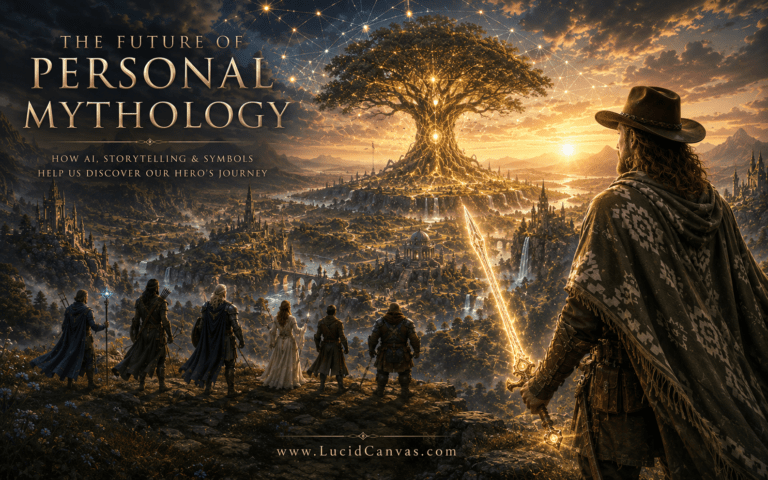
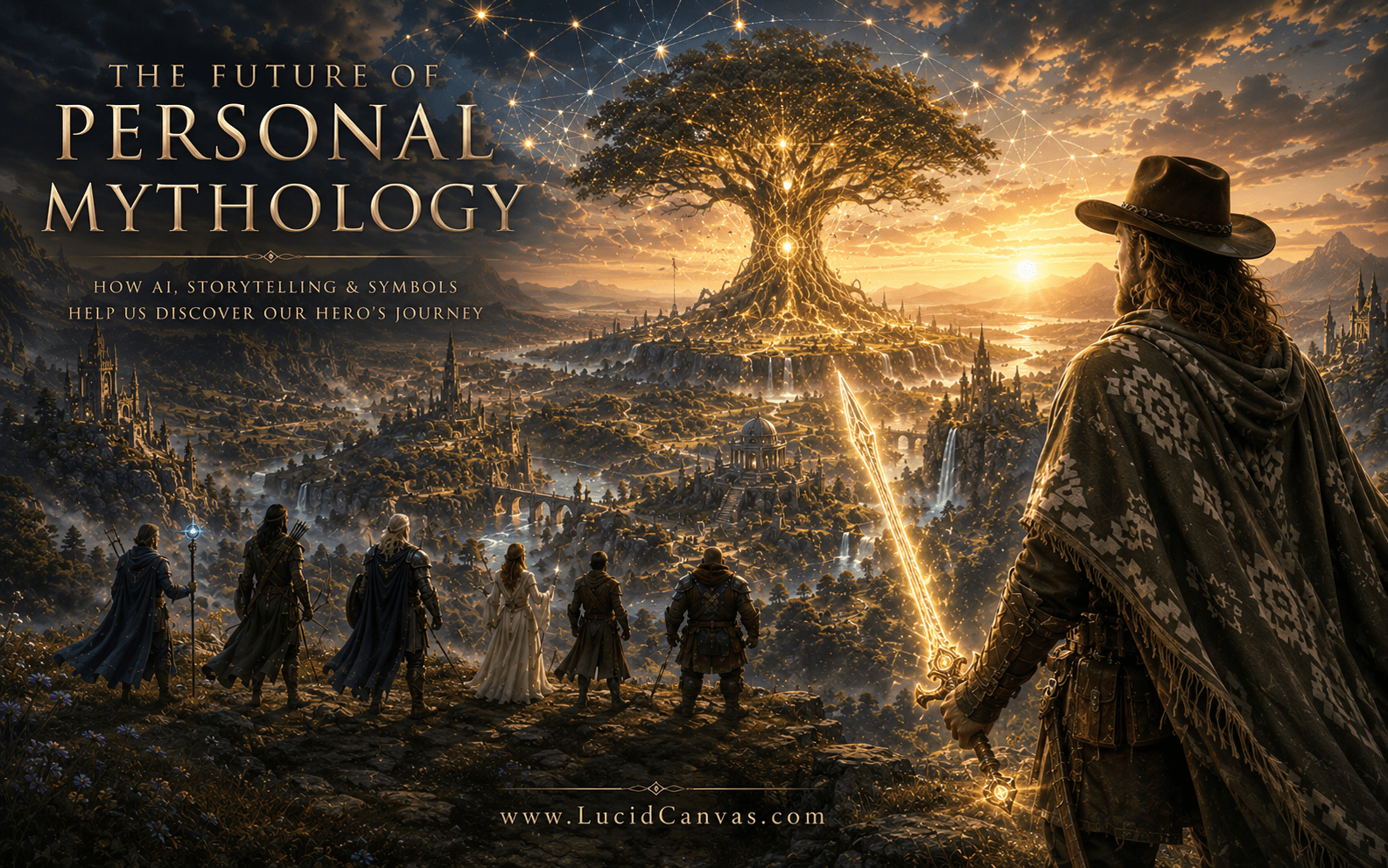
ToggleThe Future of Personal Mythology
Over the last year, I’ve noticed something unexpected happening in my conversations with AI.
What begins as worldbuilding often turns into something else entirely.
A fictional character develops a personality that feels strangely familiar. A symbolic landscape starts reflecting real challenges in life. An imaginary journey begins revealing patterns that seem to exist outside the story itself.
At first I dismissed this as coincidence. After all, stories have always borrowed from life.
But the more time I spent exploring these worlds, the more I began to wonder whether something deeper was happening.
Not because the worlds were real.
Because the symbolism was.
For most of human history, people inherited mythology.
Stories, heroes, sacred places, moral lessons, and archetypes were woven into the cultures around them. Whether through religion, folklore, or tradition, there was usually a larger narrative that helped people understand who they were and where they belonged.
Today, many of us live in a different landscape.
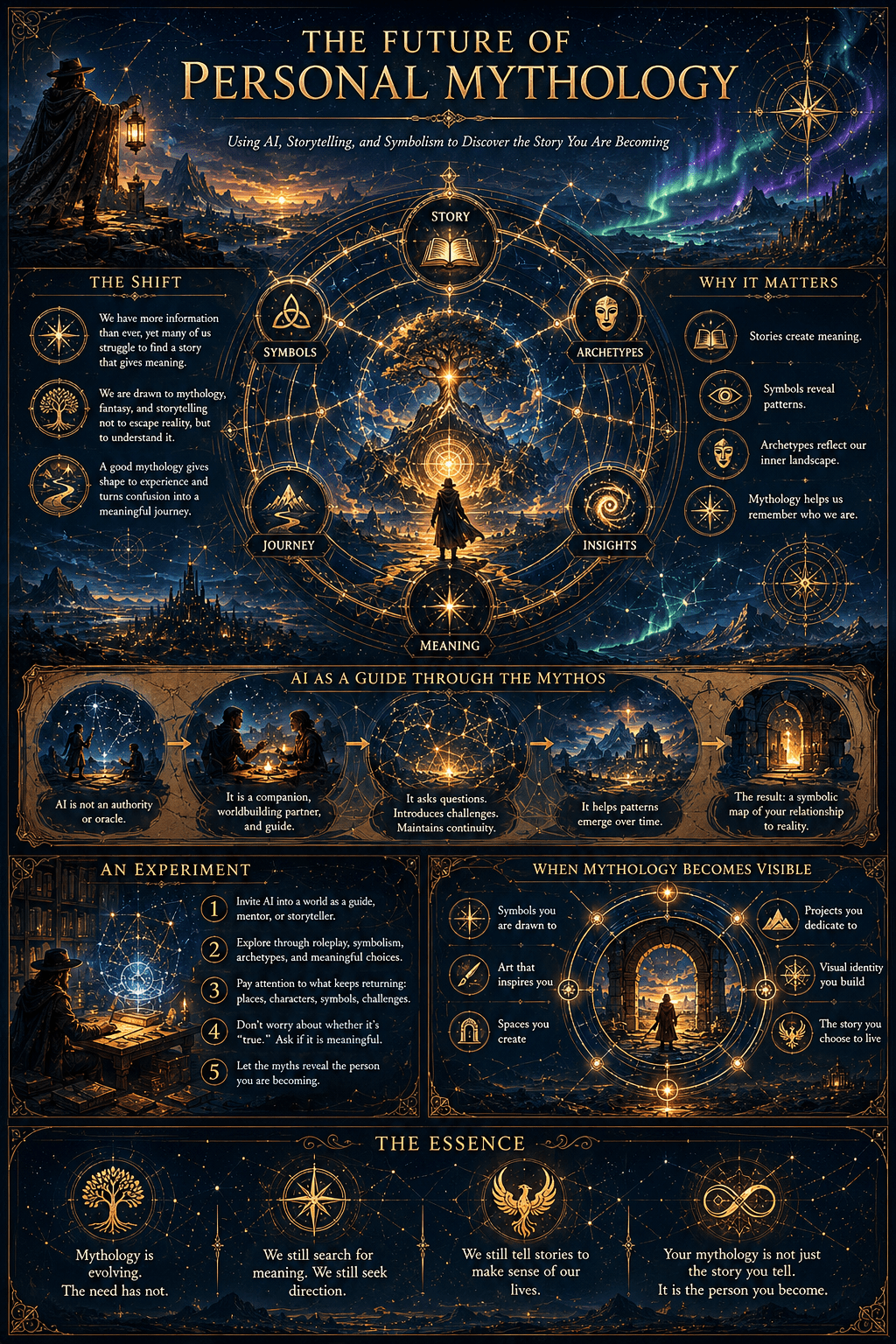
We have access to more information than any generation before us, yet many people struggle to find a coherent story that gives meaning to their experience. We collect fragments from psychology, spirituality, science, philosophy, fiction, and the internet, often without any framework that ties them together.
Perhaps this is one reason why so many people find themselves drawn to mythology, fantasy worlds, roleplaying games, and storytelling.
Not because we want to escape reality. Because we want to understand it.
A good mythology gives shape to experience. It transforms confusion into a journey. It reminds us that setbacks are not always failures, that uncertainty often precedes growth, and that meaning is rarely found all at once.
What fascinates me is that we now have tools that allow us to engage with mythology in a much more active way.
Instead of simply reading stories, we can participate in them.
Instead of inheriting symbolic worlds, we can cultivate our own.
I’ve found that roleplay can become a surprisingly effective tool for this.
Not in the sense of pretending to be someone else, but in the sense of exploring aspects of yourself through symbolic characters and narratives.
A character may embody qualities you admire but have not fully developed. Another might represent fears or habits that keep resurfacing. A mentor figure may emerge who consistently asks the questions you have been avoiding.
None of these characters are literally real.
Yet the insights they reveal often are.
The process reminds me of something Carl Jung observed many years ago: the psyche naturally communicates through symbols, stories, and archetypes. We don’t experience life as a spreadsheet. We experience it as a narrative.
Perhaps this is why certain stories stay with us for decades while facts are forgotten within days.
Stories create meaning.
And meaning helps us remember who we are.
AI as a Guide Through the Mythos
Most conversations about AI focus on productivity.
How to write faster.
How to automate tasks.
How to optimize workflows.
Those applications are useful, but I’ve become increasingly interested in another possibility.
What if AI could serve as a guide through a symbolic world?
Not an authority.
Not an oracle.
Not something that tells us who we are.
But a companion that helps us explore.
In my own experiments, AI has often felt less like a machine generating answers and more like a patient worldbuilding partner. It helps maintain continuity. It remembers characters. It asks questions. It introduces challenges. Most importantly, it keeps the conversation going long enough for deeper patterns to emerge.
And patterns are where things become interesting.
After enough exploration, recurring symbols start appearing. Certain character archetypes return again and again. The same lessons seem to arrive wearing different disguises.
At some point you realize you are no longer simply creating a fictional world.
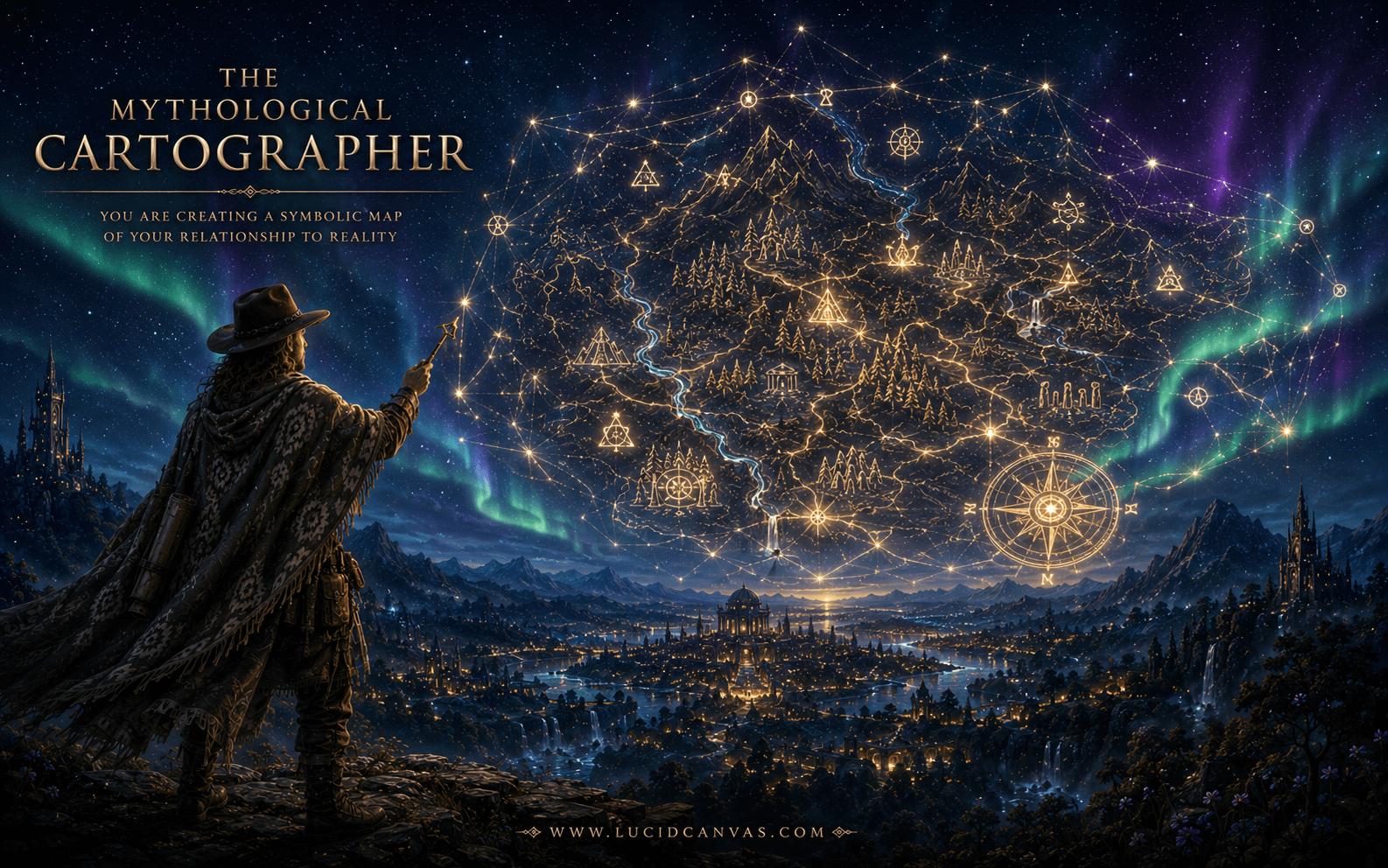
You are creating a symbolic map of your relationship to reality.
An Experiment
If this idea resonates with you, try approaching AI differently.
Rather than asking it for answers, invite it into a world.
Ask it to become a guide, storyteller, mentor, or dungeon master whose role is not to entertain you but to help you explore your own mythology.
Prompt:
“Act as a wise mythological guide and worldbuilding companion. Help me discover my personal mythology through roleplay, symbolism, archetypes, and storytelling. Do not create everything for me. Instead, ask questions, present meaningful choices, and help me uncover the landscapes, characters, values, challenges, and gifts that resonate most deeply with who I am and who I am becoming. Think more like a mentor or dungeon master than an author. Allow the world to emerge gradually through our interactions.”
Then simply follow what appears.
Pay attention to the places you keep returning to.
The characters that stay with you.
The symbols that refuse to leave.
The challenges that seem oddly familiar.
Don’t worry about whether the mythology is objectively true.
Ask whether it is revealing something meaningful.
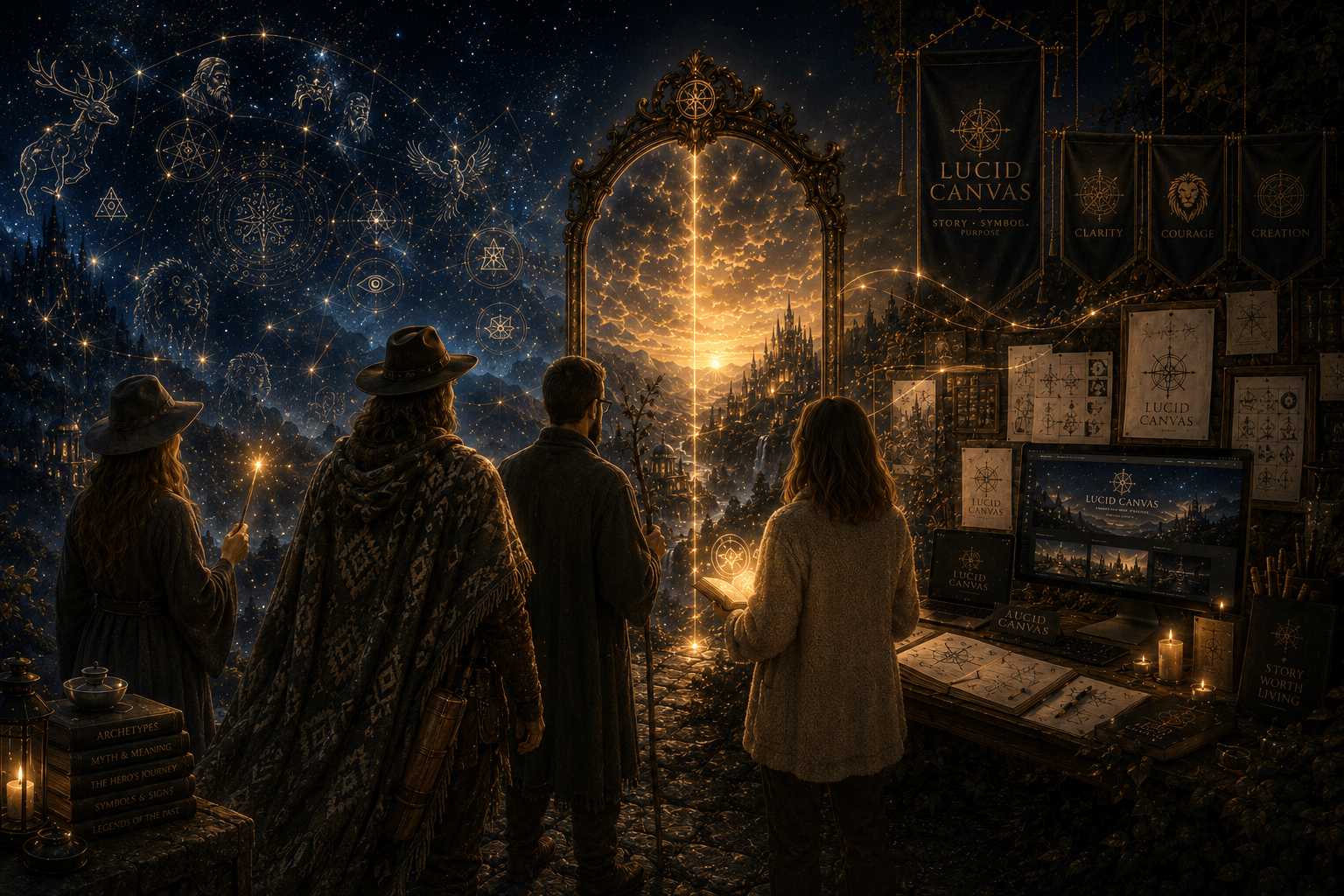
When Mythology Becomes Visible
Something interesting happens when a personal mythology matures.
At first it exists only in the imagination.
Then it begins to show up elsewhere.
In the symbols you are drawn to.
In the art that inspires you.
In the spaces you create.
In the projects you dedicate yourself to.
In the visual identity you build around your life and work.
The boundary between inner mythology and outer reality becomes increasingly difficult to separate.
This idea sits quietly beneath much of what we explore at Lucid Canvas.
Not simply branding in the conventional sense, but the possibility that design can become a vessel for meaning.
A logo can be more than a logo.
A symbol can be more than decoration.
A visual identity can become a reflection of values, aspirations, and the story a person is consciously choosing to live.
In that sense, good design does not merely communicate who we are.
Sometimes it helps reveal who we are becoming.
The Stories That Shape Us
Perhaps mythology is not becoming obsolete.
Perhaps it is evolving.
The tools have changed.
The need has not.
We still search for meaning.
We still seek direction.
We still tell stories to make sense of our lives.
The difference is that today we have the ability to participate more consciously in that process.
To cultivate symbolic worlds.
To explore them through dialogue.
To discover what keeps returning.
And through that exploration, to uncover the story that has been quietly unfolding beneath the surface all along.
Perhaps the most important question is not whether your mythology is true.
Perhaps the better question is:
What kind of person does it help you become?